Key takeaways
- A Sahara desert tour from Marrakech to Merzouga covers roughly 560 km each way, so plan for at least 3 days to avoid rushing the drive.
- Merzouga and its Erg Chebbi dunes offer the most developed camps and the tallest dunes, while Erg Chegaga near M’hamid is remoter and needs a 4×4.
- Ait Ben Haddou is a UNESCO World Heritage site inscribed in 1987 and sits on the classic route alongside Dades Valley and Todra Gorge.
- October to April is the comfortable window; midday heat in summer regularly climbs past 40C.
A Sahara desert tour from Marrakech is a multi-day road trip across the High Atlas to the dunes, most commonly ending at Merzouga and the Erg Chebbi sand sea around 560 km to the southeast. You spend one or two nights at a desert camp, ride camels at sunset, and stop at landmarks like Ait Ben Haddou and Todra Gorge on the way. This guide walks through the routes, the major stops, how to choose your destination, what a camp night feels like, and how many days to set aside.
Popular routes for a Sahara desert tour from Marrakech
Two corridors carry almost all Sahara traffic out of Marrakech, and they split within the first hour of driving.
The eastern corridor climbs the Tizi n’Tichka pass, one of the highest paved road crossings in North Africa, then drops toward Ouarzazate and continues through the Dades and Todra valleys to Merzouga. This is the classic route, and most tours from Marrakech to the Sahara desert follow it because it strings together the best-known stops in one line.
The southern corridor runs through the Draa Valley toward Zagora and M’hamid, the jumping-off point for Erg Chegaga. It is shorter in paved kilometres but ends with an off-road stretch that a standard car cannot manage.
Expect long days in the vehicle on either route. The drive to Merzouga runs roughly nine to ten hours of pure driving, which is why reputable operators split it across two days rather than attempting it in one punishing push.
Key stops: Ait Ben Haddou, Dades Valley, and Todra Gorge
The stops are the reason a slower itinerary beats a fast one.
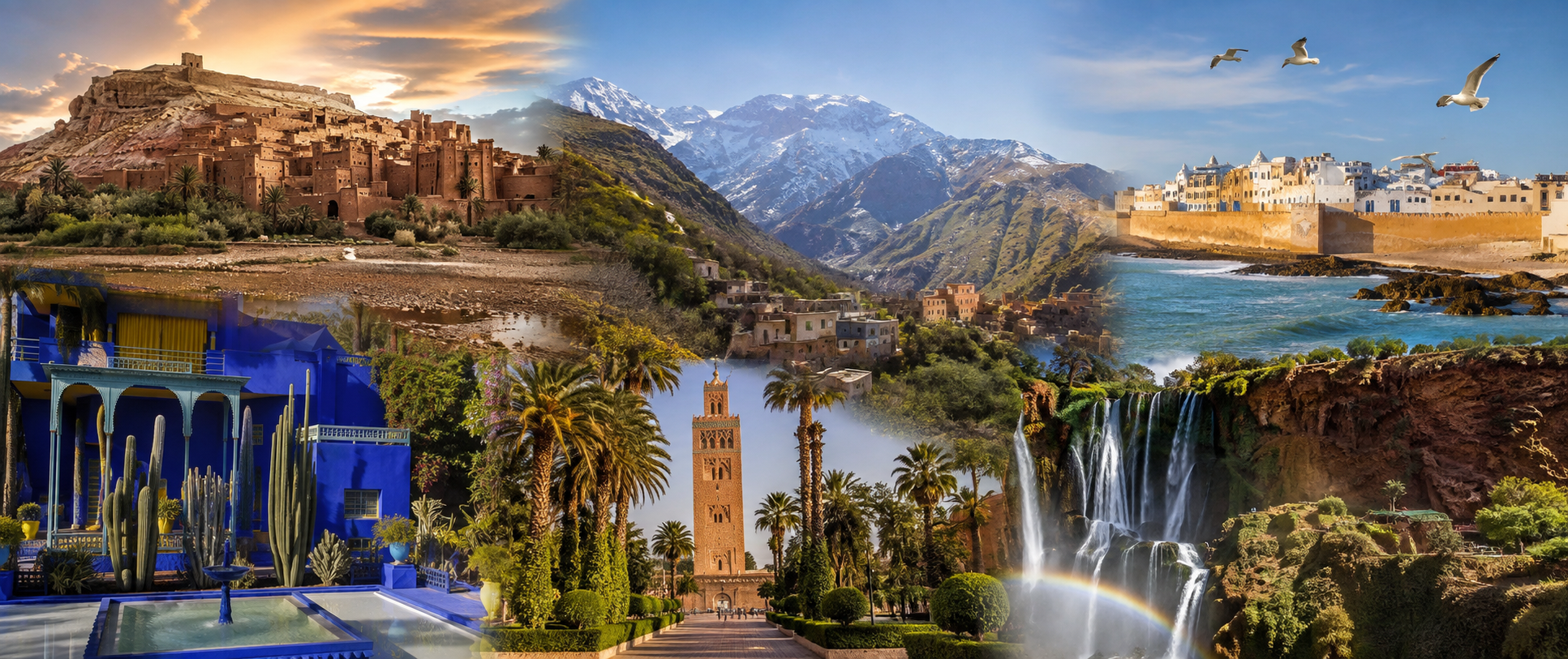
Ait Ben Haddou is a fortified earthen village, or ksar, on the old caravan route between the Sahara and Marrakech. It was inscribed on the UNESCO World Heritage List in 1987 as an outstanding example of southern Moroccan earthen architecture (UNESCO World Heritage Centre). Film crews have used it for decades, so the mud-brick towers may look familiar before you arrive.
Dades Valley, often reached late on the first day, is a corridor of kasbahs, palm groves, and tight switchback roads carved between rose-red cliffs. It is a common overnight stop before the push to the dunes.
Todra Gorge is a limestone canyon where sheer walls rise steeply above a narrow river channel, squeezing down to a slot only a few metres wide at its tightest point. Walking the shaded floor in the morning, before the tour buses, is one of the quieter highlights of the route.
Choosing between Merzouga and Erg Chegaga
Your destination decision shapes the whole trip, so settle it before booking.
Merzouga and Erg Chebbi draw the majority of visitors. The dunes here are the tallest in Morocco, rolling up to around 150 metres, and the village has the most developed cluster of camps, from basic to genuinely luxurious. Access is straightforward: paved road to the dune edge, then a short camel or 4×4 transfer into camp. For a first desert trip, this is the safer, simpler choice.
Erg Chegaga, reached via M’hamid, is the remoter option. The dunes are lower but spread across a vast, far emptier sea of sand, and the final leg is an off-road 4×4 run of roughly an hour. Fewer camps and fewer visitors mean a wilder feel, at the cost of a rougher approach and less infrastructure.
A rough rule: pick Merzouga if you want the iconic big dunes and easy logistics, and Erg Chegaga if solitude matters more than convenience.
The overnight desert camp and camel rides
The camp night is the emotional centre of the trip, not just a place to sleep.
Vehicles drop you at the edge of the sand in the late afternoon. From there, a camel caravan usually carries you the last stretch into camp, a slow, swaying ride of about an hour timed to reach the dunes as the light turns gold. If camels are not for you, most camps can send a 4×4 instead.
Camps range widely. Standard tents share basic bathrooms and serve a communal tagine dinner around a fire, often with Berber drumming. Premium camps add private en-suite tents, proper beds, and plated meals. Either way, the two things everyone remembers are the silence after the music stops and the density of the stars, far from any town glow.
Nights get cold, especially from late autumn through winter, when desert temperatures can fall sharply after dark even when days are warm. Pack a fleece and a hat regardless of the season.
How many days you need for a worthwhile trip
The honest minimum for Merzouga is three days and two nights. That gives you a full first day of driving and stops, one night in the desert, and a second driving day back. Two-day tours are sold, but they compress the round trip into back-to-back marathon drives with barely an afternoon in the dunes.
If you can spare it, a four-day loop relieves the pressure: it lets you linger at Ait Ben Haddou and Todra Gorge, add a second desert night, or return via a different valley rather than retracing the same road. Erg Chegaga trips benefit even more from the extra day because of the off-road access.
For context, this is a different style of trip from a mountain itinerary. If you are also weighing a High Atlas climb, our guide to the best time to climb Mount Toubkal explains how the seasons differ from desert timing.
Practical tips on transport, comfort, and timing
A few decisions make the difference between a smooth tour and a long slog.
Transport. Private tours give you control over stops and pace; shared minibus tours are cheaper but keep to a fixed schedule. For Erg Chegaga, confirm that the final leg uses a proper 4×4, not a standard van.
Timing. October through April is the comfortable window, with warm, clear days and cool nights. Summer midday heat in the dunes routinely passes 40C, which turns walks on the sand into an endurance test. Spring also brings the rose harvest to the valleys along the route.
Comfort. Bring layers, sunglasses, a scarf for blowing sand, sturdy shoes for the gorges, and more water than you think you need. Phone signal fades near the dunes, so download maps and music before you leave Ouarzazate.
Booking. Clarify exactly what is included: meals, camp category, driver versus guide, and whether entrance stops are built into the schedule. A clear inclusions list is the simplest way to compare operators. As a Morocco-based operator running both desert tours and Atlas treks, Toubkal Treks structures itineraries around these inclusions, much as we do for our guided Toubkal trek packages.
Decide your destination first, Merzouga or Erg Chegaga, then block out at least three days and book the season that matches the comfort you want. With those two choices locked, the rest of the planning falls into place and you can reach out to an operator with a clear brief rather than a blank slate.
Frequently asked questions
How many days do you need for a Sahara desert tour from Marrakech?
Three days is the realistic minimum for Merzouga, which balances the long drive with one desert night. Two-day trips exist but spend almost all their time in the vehicle.
Is Merzouga or Erg Chegaga better for a first desert trip?
Merzouga suits most first-timers because its camps are well established and its Erg Chebbi dunes are the tallest in Morocco. Erg Chegaga is better if you want remoteness and fewer crowds.
When is the best time to visit the Moroccan Sahara?
October to April offers pleasant days and cool nights. Avoid June to August, when daytime temperatures in the dunes regularly exceed 40C.
Do you ride camels the whole way into the desert?
No. Vehicles reach the edge of the dunes, and the camel ride is a short sunset leg into camp, usually around an hour each way.